• March, 2010: Geodetics awarded a firm-fixed-price contract for real-time enhanced network global positioning systems units.  Work is to be performed in San Diego with an estimated completion date of Aug. 21, 2012.  U.S. Army Test & Evaluation Command, Mission Support Contracting Activity, Fort Hood, Texas, is the contracting activity (W9115U-08-D-0001).
  • August, 2009: Long Beach Gas and Oil Department awards contract to provide Real-Time Network software and services.

  • View More News

Technology Products

GPS Positioning   |   Epoch-by-Epoch® Advantages   |   GPS/INS Integration

GPS Positioning

Geodetics' technologies provide three-dimensional Precise Instantaneous GPS ("ΠGPS") positioning for applications ranging from positioning a single static/dynamic object, to monitoring many static, deforming and dynamic objects in a wide-area network simultaneously. The technologies can also provide very accurate attitude information for dynamic objects.

The technologies are based on Geodetics' proprietary RNA (Rapid Network Analysis) module with Epoch-by-Epoch® technology, a new class of instantaneous, real-time GPS positioning algorithms. This innovative technology provides an independent estimate of position for each epoch of dual-frequency (L1 and L2) observations to five or more GPS satellites. Geodetics products also supports geodetic-quality single-frequency (L1) observations for localized networks.

top

Epoch-by-Epoch® Advantages

  • Provides instantaneous initialization and re-initialization compared to the typical 30-45 seconds for RTK positioning

  • Unaffected by cycle slips and receiver losses of lock

  • Easier to detect and reject bad data points compared to batch or RTK positioning methods

  • Robust estimation of multiple single-epoch static positions improves site coordinate precision vs conventional batch processing

  • Extremely efficient algorithms allow the simultaneous, real-time network positioning of multiple (> 50) receivers sampling at high receiver sampling rates

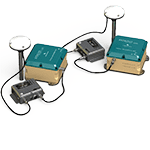
Geodetics' Real Time Dynamic (RTD) family of products, based on Epoch-by-Epoch® technology, controls completely the flow of data from networks ranging from two to hundreds of GPS instruments into multiple data servers, data archives, and clients (rovers).

RTD's server/client applications support Precise Instantaneous Network ("PIN") positioning, while simultaneously monitoring the integrity and possible deformation of the base network, Epoch-by-Epoch®.

PIN positioning is a new network-based real-time methodology, not requiring multi-epoch initialization and re-initialization inherent in conventional RTK surveying and network RTK methods. Geodetics technologies have been especially designed for real-time, wireless environments, and the software is optimized for extremely fast dissemination and processing of data.

top

GPS/INS Integration

GPS/INS Integration refers to the use of GPS satellite signals to correct or calibrate a solution from an Inertial Navigation System (INS). These two sensors work hand-in-hand where each compensates for weaknesses of the other.

On one hand, inertial navigation systems provide an accurate solution for only a short period of time after which time, drift degrades the solution. GPS can be used to correct the INS and reduce the drift. On the other hand, GPS can provide an accurate solution only when there is visibility to the GPS constellation. When the view to the constellation is occluded, the INS can carry the solution until visibility to the constellation is regained.

The benefits of using GPS with an INS are that the INS may be calibrated by the GPS signals and that the INS can provide position and angle updates at a faster sample rate than GPS. For high dynamic vehicles such as missiles and aircraft, INS fills in the gaps between GPS positions. Additionally, GPS may lose its signal and the INS can continue to compute the position and angle during the period of lost GPS signal. The two systems are complementary and are often employed together.

top